Morning! 🌅 ☕️
This is it.
Every sound is gone.
Don't scroll yet.
Say it out loud. All nine sounds. From memory.
If you got it - you just did something real. Five days ago this was a string of unfamiliar sounds. Today it lives in your head, ready to use.
That's not an app streak. That's actual Japanese.
In today's email...
-
📱 Day 5: Full recall - every sound is blank
-
🌟 Why this small greeting matters so much - and always will
-
🏃 How to use おはようございます this weekend, for real
📧 subscribe here | ⭐ manage subscription | 📩 keep going after day 30 | 📆 yesterday’s newsletter
MEMORIZE 🧠
_ _ _ _ _ _ _ _ _
_ - _ - _ - _ - _ - _ - _ - _ - _
(all nine sounds - from memory)
As always, the answer key and audio are at the bottom of this email.
CULTURAL MOMENT 🌅
Here's why a phrase this small matters so much: it's the door.
おはようございます is, for most people in Japan, the first thing said to another person each day. Before any business, before any conversation, there's the greeting - the small bow, the warm word, the moment of I see you. It isn't decoration. It's the opening move of nearly every morning, repeated across a whole country, and it's been that way for generations. Greetings sit at the very foundation of how people treat one another here, which is exactly why children learn aisatsu before almost anything else.
Think about what you've actually done this week. You didn't memorize a vocabulary list. You didn't earn points on an app. You sat with one real phrase - the one people genuinely say, first thing, every morning - and let it settle into your memory through a few minutes of daily practice. That's a completely different kind of learning. It sticks because the phrase has meaning and a moment attached to it. You weren't drilling sounds. You were learning how to open a day the Japanese way.
That's the difference between cultural fluency and textbook Japanese. A textbook gives you the words. Cultural fluency gives you the moment - when to say it, how to say it, the little bow that goes with it, what it means to the person who hears it. You now have all of that for おはようございます. So use it. This weekend, find a real morning moment - greet someone, dip your head slightly, and say it warmly, like you mean it. Watch how naturally it lands.
おはようございます. Nine small sounds. A door you can now open. Yours.
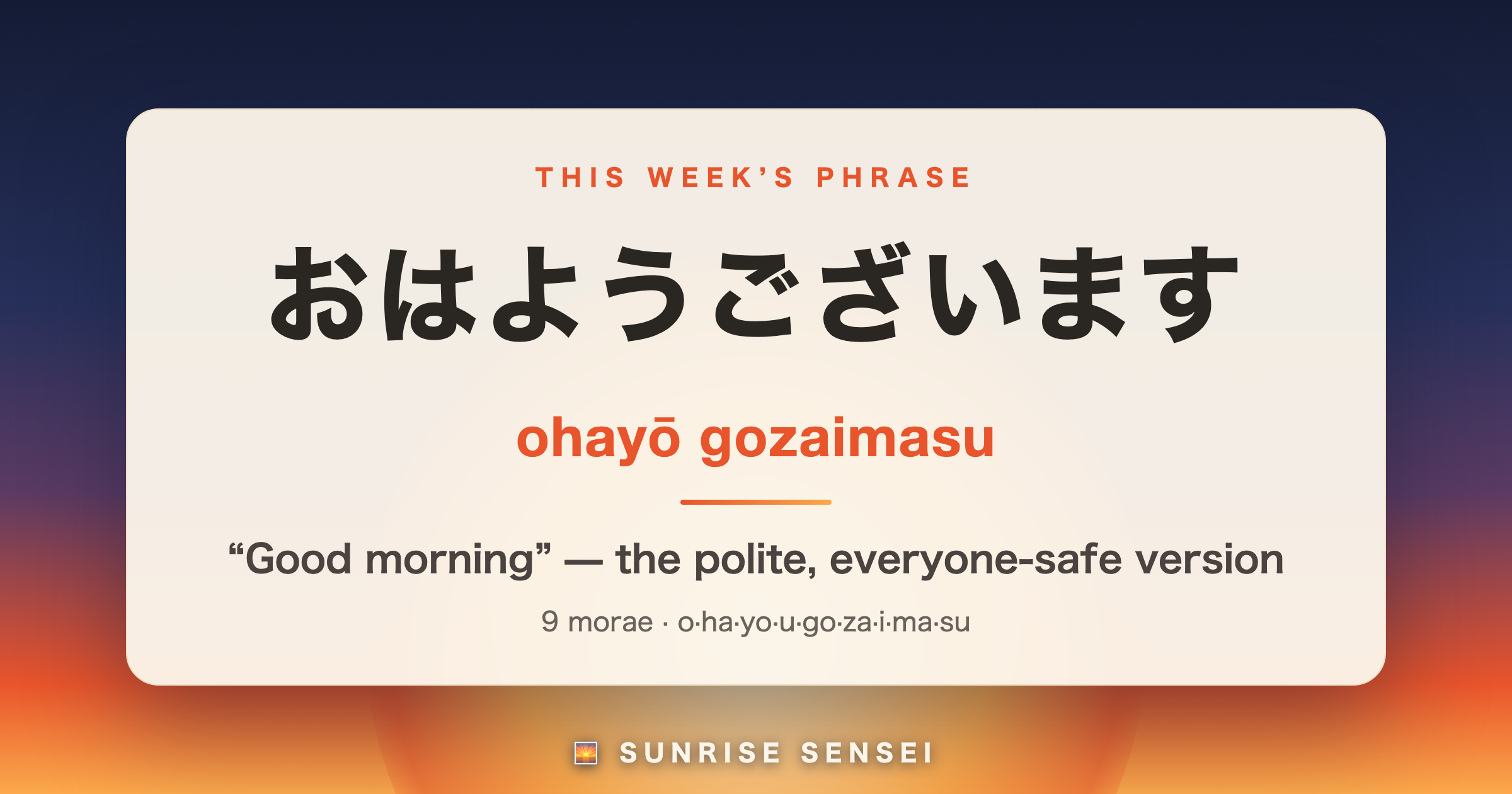
EVERYTHING YOU LEARNED THIS WEEK 📦
Five mornings, one phrase, and quietly a lot more than one phrase:
-
The greeting itself. おはようございます (ohayō gozaimasu) - polite, everyone-safe "good morning," nine morae long.
-
The two halves. おはよう (the greeting, casual on its own) + ございます (the block of politeness). Both reusable far beyond this phrase.
-
The politeness dial. Casual おはよう for people you're close to; polite おはようございます for everyone else. When unsure, go polite - it's never wrong.
-
The sound rules. Mora timing, the long ō that the う creates, and the near-silent final す that makes ございます land as "gozaimas."
-
The culture. Aisatsu as social glue, the small bow that travels with the words, gosen-gorei (words first, bow after), and the workplace quirk where おはようございます opens a shift at any hour.
Not bad for five short mornings.
SAY IT LIKE A LOCAL 🗣️
One last pronunciation pass, all four rules at once. Say the phrase slowly and check yourself against each line:
1. Nine even beats     o·ha·yo·u·go·za·i·ma·su   not English stress
2. Long ō              おはよう = 4 beats         not a clipped "ohayo"
3. Buzzing ざ           za, like "zebra"           not "sa" or "ja"
4. Whispered す         "gozaimas"                 not "gozai-ma-SOO"
Then say it once at full speed, warmly, the way you'd actually greet someone. That version - relaxed, unhurried, slightly nodded - is the one that counts.
COMMON MISTAKE ⚠️
Waiting until you're "ready" to say it to a real person.
This is the mistake that actually costs people their Japanese - not a mispronounced す. The phrase is finished. It's in your head. The only thing left is the small, slightly awkward act of letting it out of your mouth in front of someone.
You don't need more practice first. おはようございます is a greeting: low stakes, three seconds, and the person you say it to will be pleased rather than critical. Japanese speakers are famously warm toward learners who try. The first time is the only hard one.
IN THE WILD 👂
If you ever land in Japan, this is the phrase you'll hear before you hear anything else. It's waiting at the hotel front desk at 7am. At the station kiosk. From the taxi driver as the door swings open. From the staff at the café before you've even chosen a table. You'll hear it dozens of times in a single morning - and now, every one of them will land as words you understand rather than noise.
USE IT TODAY ✅
The week's final challenge - and it happens off the page.
-
Say it out loud to one actual human this weekend. Partner, friend, coworker, barista. They don't need to speak Japanese. Say おはようございます, dip your head slightly, and smile. That's it. That's the whole thing.
-
Set it as tomorrow's first move. Before the phone, before the coffee: say it once, out loud, to the morning. A phrase used once a day never decays.
-
Teach it to someone. Explain the two halves and why ございます matters. Teaching a thing is the fastest way to find out you actually own it - and you do.
🌅 You're getting real value here. Imagine practicing every phrase out loud with Yuki, your Sunrise Sensei companion.
HEAR THE JAPANESE AUDIO 🌅
Pro tip: Listen three times.
Once for general meaning.
Once following along with the text.
Once with your eyes closed, focusing purely on pronunciation and rhythm.
ANSWER KEY ✅
おはようございます (ohayō gozaimasu).
"Good morning" - the polite, everyone-safe version.
Today's disappeared sounds: お, は, よ, う, ご, ざ, い, ま, す (o, ha, yo, u, go, za, i, ma, su)
🌅 You nailed it. Ready to go full Japanese?
Billed today · cancel anytime →
How was today's newsletter? Your feedback helps us create better Japanese content for you! (I read every single one!)
🎯 バッチリ! (Batchiri! - Nailed it) My Japanese is growing →
📚 まあまあ (Māmā - so-so). Here's what would help →
See you tomorrow! - 🌅 The Sunrise Sensei Team
Looking for resources?
Get the audio by subscribing below 👇
There's a better way to learn.
Sunrise Sensei delivers one memorable disappearing Japanese phrase to your inbox daily. It’s a simple, effective way to build fluency without the frustration.