Morning! 🌅 ☕️
Six sounds gone today.
Only three remain on the page.
Before you scroll - say the full phrase out loud from memory.
Don't check. Just try.
In today's email...
-
📱 Day 4: Six blanks - you're almost at full recall
-
🌟 What aisatsu really does - the quiet social glue of daily life in Japan
-
🏃 A closer look at おはよう and the polite お that softens it
📧 subscribe here | ⭐ manage subscription | 📩 keep going after day 30 | 📆 yesterday’s newsletter
MEMORIZE 🧠
おはよ _ _ _ _ _ _
o - ha - yo - _ - _ - _ - _ - _ - _
(almost the whole thing is memory now)
As always, the answer key and audio are at the bottom of this email.
CULTURAL MOMENT 🌅
When someone in Japan says おはようございます, they're doing more than reporting the time of day. They're performing aisatsu - and aisatsu is one of the quiet forces that holds daily life together.
Think of greetings as social glue. A morning greeting between neighbors keeps a street feeling like a community. A coworker's おはようございます as they arrive smooths the start of a shared workday. Children are taught aisatsu early, at home and at school, not as empty manners but as a way of acknowledging the people around them - I see you, we're in this day together. That habit follows people for life.
What's striking, especially from an American point of view, is how reciprocal it is. A greeting given is a greeting returned, almost without exception. Skipping someone's おはようございます - leaving it hanging - registers more than skipping a "morning" might back home. The small exchange matters because it's the daily proof that the relationship is still warm and intact. It costs a second and it keeps things running.
This is also why the morning greeting sets a tone. Offered warmly, with a small bow, it opens the day on a note of respect and ease - for the person you greet and for you. You're not just checking a politeness box. You're doing the same small, human thing that millions of people across Japan do every morning to stay gently connected to each other.
And after four days, you're not just repeating a phrase anymore. You're starting to carry the whole little ritual - the words, the warmth, the reason behind it.
WORD SPOTLIGHT 🔍️
Today's disappeared sounds: う (u) and ご (go) - leaving only おはよ (o-ha-yo) on the page.
With almost everything blank, this is the perfect moment to look closely at the part you're clinging to: おはよう (ohayō), the casual "good morning" hiding inside the polite one.
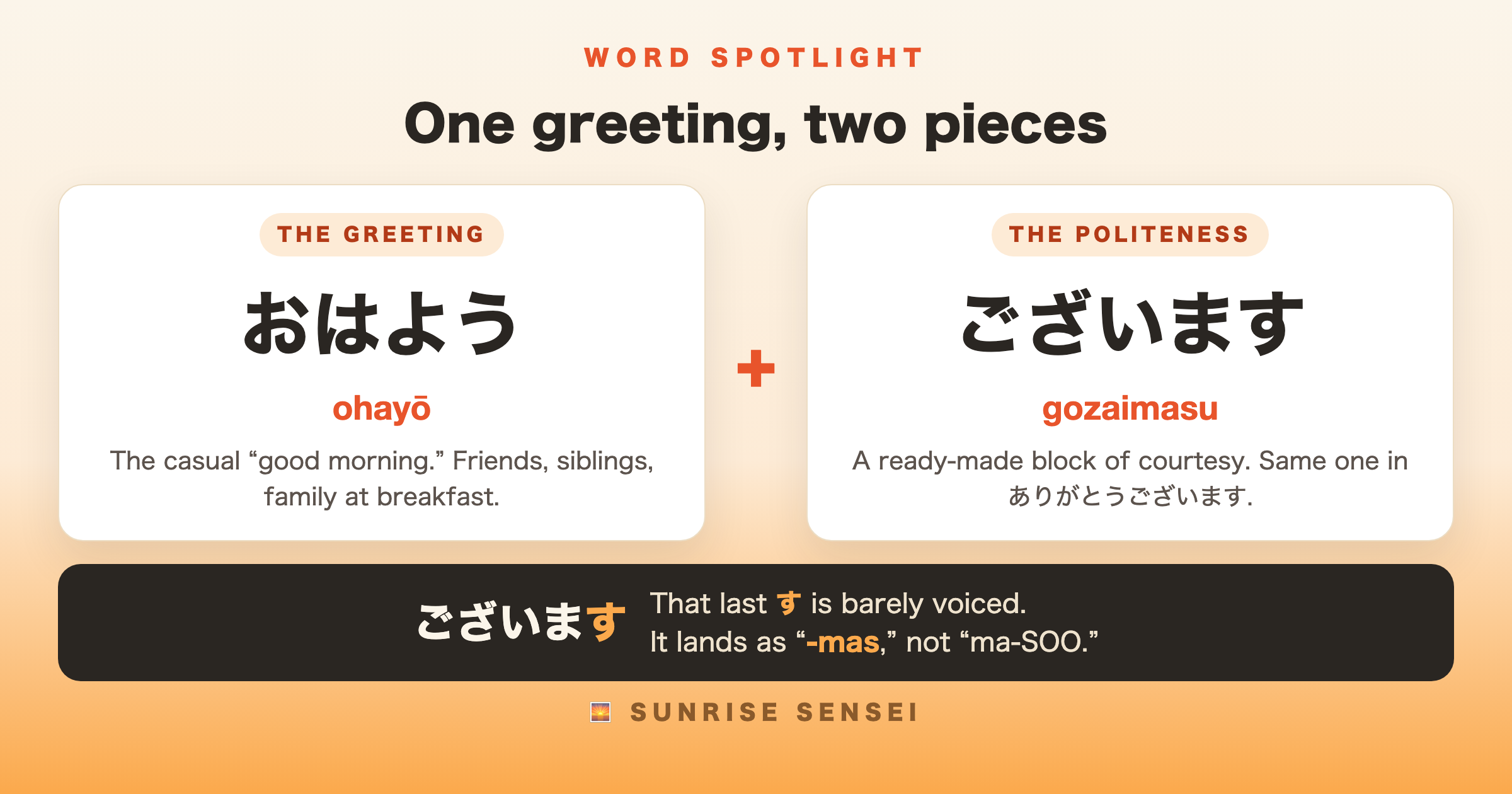
Look at that お at the very front. It's the same soft, polite prefix Japanese loves to attach to everyday words to make them gentler and warmer - you'll meet it again and again as you learn. Here it sits on top of the idea of "early." As we saw on Day 1, おはよう is most often said to come from お早い / お早く (o-hayai / o-hayaku, "early") - a courteous little nod to someone who's up and about at the start of the day. That お has been softening the word from the beginning.
You'll spot the same お all over ordinary Japanese once you know to look:
お茶      o-cha       tea
お水      o-mizu      water
お名前    o-namae     (your) name
お元気     o-genki     well / in good spirits
Now put the two layers side by side. おはよう already carries one layer of politeness in that お. Add ございます and you stack a second, stronger layer of courtesy on top. That's the whole architecture of this phrase: a gentle base (おはよう) plus a polite finish (ございます). Understanding that, you stop seeing おはようございます as a random string of sounds to memorize - and start seeing it as two friendly pieces you can now recognize anywhere.
SAY IT LIKE A LOCAL 🗣️
Today's blanks include the う - and that う is doing quiet, important work.
It doesn't get its own "oo" sound. It lengthens the よ before it, turning one beat into two. That's the whole reason we write ohayō with a bar over the o rather than "ohayo."
おはよ    o-ha-yo      3 beats   ✗ clipped, sounds unfinished
おはよう   o-ha-yo-u    4 beats   ✓ the real word
Hold that よ for a full extra beat. English speakers, trained to rush unstressed vowels, almost always cut it short - and a short ō is one of the most common accent tells in the phrase.
Say them side by side right now: "ohayo" then "ohayō." That extra beat is the difference.
COMMON MISTAKE ⚠️
Using おはようございます in the afternoon.
The phrase means "good morning," and in ordinary life it's used like one - roughly from waking up until late morning. Once you're past about 10 or 11am, the everyday greeting shifts to こんにちは (konnichiwa, "hello / good day"), and in the evening to こんばんは (konbanwa, "good evening"). Greeting a shopkeeper with おはようございます at 3pm is a small, harmless slip, but it's a noticeable one.
The exception is the one we met on Day 2: in certain workplaces - theaters, studios, kitchens, plenty of part-time jobs - おはようございます marks the start of your shift, whatever the clock says. That's an in-group workplace convention, not a general rule. Out on the street, follow the sun.
IN THE WILD 👂
Pay attention to how short the whole exchange is. Two people pass in an apartment hallway. One says おはようございます with a dip of the head; the other returns it. Nobody stops walking. Three seconds, total. The greeting isn't the start of a conversation - most of the time, it is the entire interaction. That's what makes it so easy to actually use.
USE IT TODAY ✅
You're one day from full recall. Make today count.
-
Say it before you read it. Cover this email, say all nine sounds out loud, then scroll to the answer key. If you stumble on the ざいます - good. That's the exact spot to drill.
-
Stretch the ō deliberately. Ten reps of just おはよう, holding that fourth beat a touch longer than feels natural. Overcorrect today; it'll settle into the right place tomorrow.
-
Say it to someone real. Not the mirror this time. A partner, a roommate, a coworker, the dog. Words first, then a small nod. Tomorrow's blank page is much less intimidating when the phrase has already left your mouth in front of another living creature.
🌅 You're getting real value here. Imagine practicing every phrase out loud with Yuki, your Sunrise Sensei companion.
HEAR THE JAPANESE AUDIO 🌅
Pro tip: Listen three times.
Once for general meaning.
Once following along with the text.
Once with your eyes closed, focusing purely on pronunciation and rhythm.
ANSWER KEY ✅
おはよ う ご ざ い ま す (ohayō gozaimasu).
"Good morning" - the polite, everyone-safe version.
Today's disappeared sounds: う (u), ご (go), ざ (za), い (i), ま (ma), す (su)
🌅 You nailed it. Ready to go full Japanese?
Billed today · cancel anytime →
How was today's newsletter? Your feedback helps us create better Japanese content for you! (I read every single one!)
🎯 バッチリ! (Batchiri! - Nailed it) My Japanese is growing →
📚 まあまあ (Māmā - so-so). Here's what would help →
See you tomorrow! - 🌅 The Sunrise Sensei Team
Looking for resources?
Get the audio by subscribing below 👇
There's a better way to learn.
Sunrise Sensei delivers one memorable disappearing Japanese phrase to your inbox daily. It’s a simple, effective way to build fluency without the frustration.