Morning! 🌅 ☕️
You say it every day without thinking. "Good morning."
Someone passes you in the hall. A barista hands you your coffee. You mumble it, half-awake, and move on.
In Japan, that same small moment carries a little more weight. The morning greeting isn't throwaway - it's the first thread of connection in the day, and there's a whole gentle culture built around getting it right.
Meet its Japanese cousin.
おはようございます (ohayō gozaimasu) - "good morning."
Say it slowly: oh-ha-YOH go-zai-mahs. (That final "u" is barely there - more breath than sound.)
This is the polite, everyone-safe way to say good morning in Japan - to a neighbor, a colleague, a shopkeeper, a stranger on your morning walk. This week, you're going to own it.
In today's email...
-
📱 Day 1: The full phrase - read it, say it, start locking it in
-
🌟 The culture of aisatsu (greetings) and why mornings matter in Japan
-
🏃 Exactly when to use the polite おはようございます vs. the casual おはよう
📧 subscribe here | ⭐ manage subscription | 📩 keep going after day 30 | 📆 yesterday’s newsletter
MEMORIZE 🧠
おはようございます
o - ha - yo - u - go - za - i - ma - su
(ohayō gozaimasu - "good morning," politely)
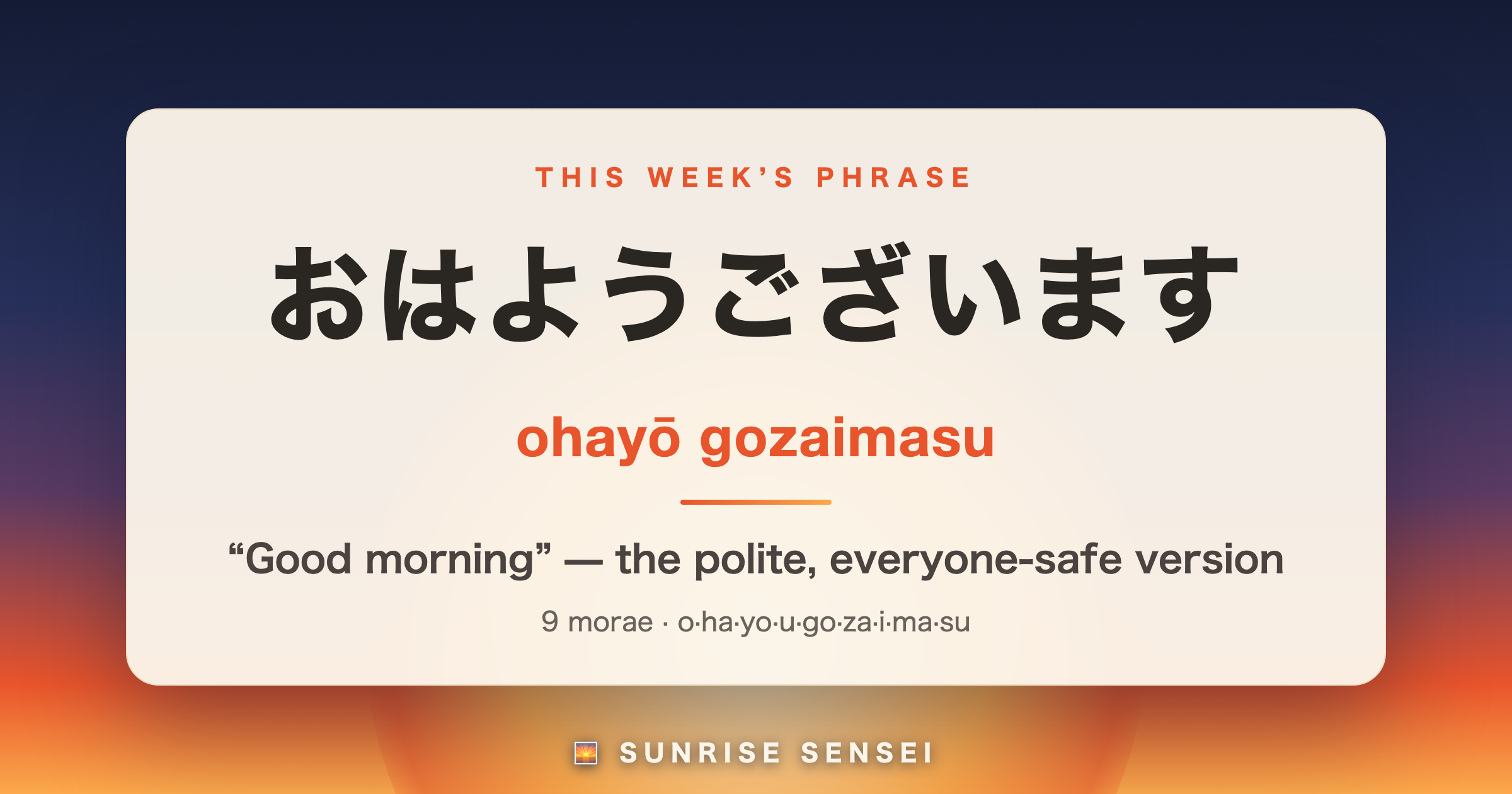
As always, the answer key and audio are at the bottom of this email.
SAY IT LIKE A LOCAL 🗣️
Here's the single biggest shift for an English speaker: Japanese doesn't punch syllables the way English does.
In English we hammer one syllable and swallow the rest - to-MOR-row, ba-NA-na. Japanese doesn't work like that. It's mora-timed: the phrase is built from nine small beats of roughly equal length, and you give each one about the same amount of time. Try tapping the table once per beat:
お  は  よ  う  ご  ざ  い  ま  す
o   ha  yo  u   go  za  i   ma  su
1   2   3   4   5   6   7   8   9
Three things to get right:
-
よう is TWO beats, not one. The う doesn't make its own sound here - it stretches the よ. That's why we write it ohayō with the bar over the o. Say "yo" and then hold it for one extra beat. Clip it to a short "ohayo" and it sounds abrupt.
-
The final す is barely voiced. In natural speech the "u" in す drops out almost entirely at the end of a phrase, so ございます lands as "gozaimas" - not "gozai-ma-SOO." This one change alone makes a beginner sound dramatically more natural.
-
Keep it flat and gentle. There's a soft lift around the よう and then the rest settles calmly. No big stressed syllable, no rising question tone at the end. Even, warm, unhurried - like the morning it belongs to.
CULTURAL MOMENT 🌅
In Japan, greetings have a name and a quiet status of their own: aisatsu (挨拶). Aisatsu covers the small spoken rituals that open an interaction - good morning, hello, thank you, welcome in. From childhood, people are taught that a clear, warm aisatsu is one of the most basic forms of respect. Schools put it on the wall. Workplaces open the day with it. It isn't treated as filler - it's treated as character.
おはようございます is the morning member of that family. You'll hear it everywhere from around dawn through late morning - neighbors sweeping the front step, coworkers arriving, a shopkeeper raising the shutter. It usually travels with a small bow or a dip of the head. The words and the little bow go together; one without the other can feel unfinished.
Here's the part that surprises most beginners: the ございます (gozaimasu) at the end is what makes it polite. Plain おはよう (ohayō) on its own is the casual version - what you'd say to a close friend, a sibling, a kid. Add ございます and it becomes teineigo (丁寧語, polite speech), safe for anyone you don't know well or simply want to show a little respect to.
That's why おはようございます is such a good first phrase to truly own. When you're not sure which version fits, the longer, polite one is never wrong. Defaulting to おはようございます makes you sound considerate from your very first word of Japanese - and a warm morning greeting quietly sets the tone for everything that comes after it.
IN THE WILD 👂
Where this phrase actually lives, on an ordinary Tuesday:
-
The convenience store at 7am. You walk in; the staff calls out a greeting. (They'll often use いらっしゃいませ - irasshaimase, "welcome in" - to customers, but staff greet each other with おはようございます.)
-
The office entrance. Everyone arriving says it to everyone already seated. It's near-automatic and near-universal.
-
The elevator, the hallway, the apartment lobby. Neighbors trade it in passing, usually with a small nod.
-
School gates. Teachers greet students with it every single morning - one of the first phrases Japanese children learn to say properly.
WORD SPOTLIGHT 🔍️
Today's focus: the two halves - おはよう (ohayō) and ございます (gozaimasu).
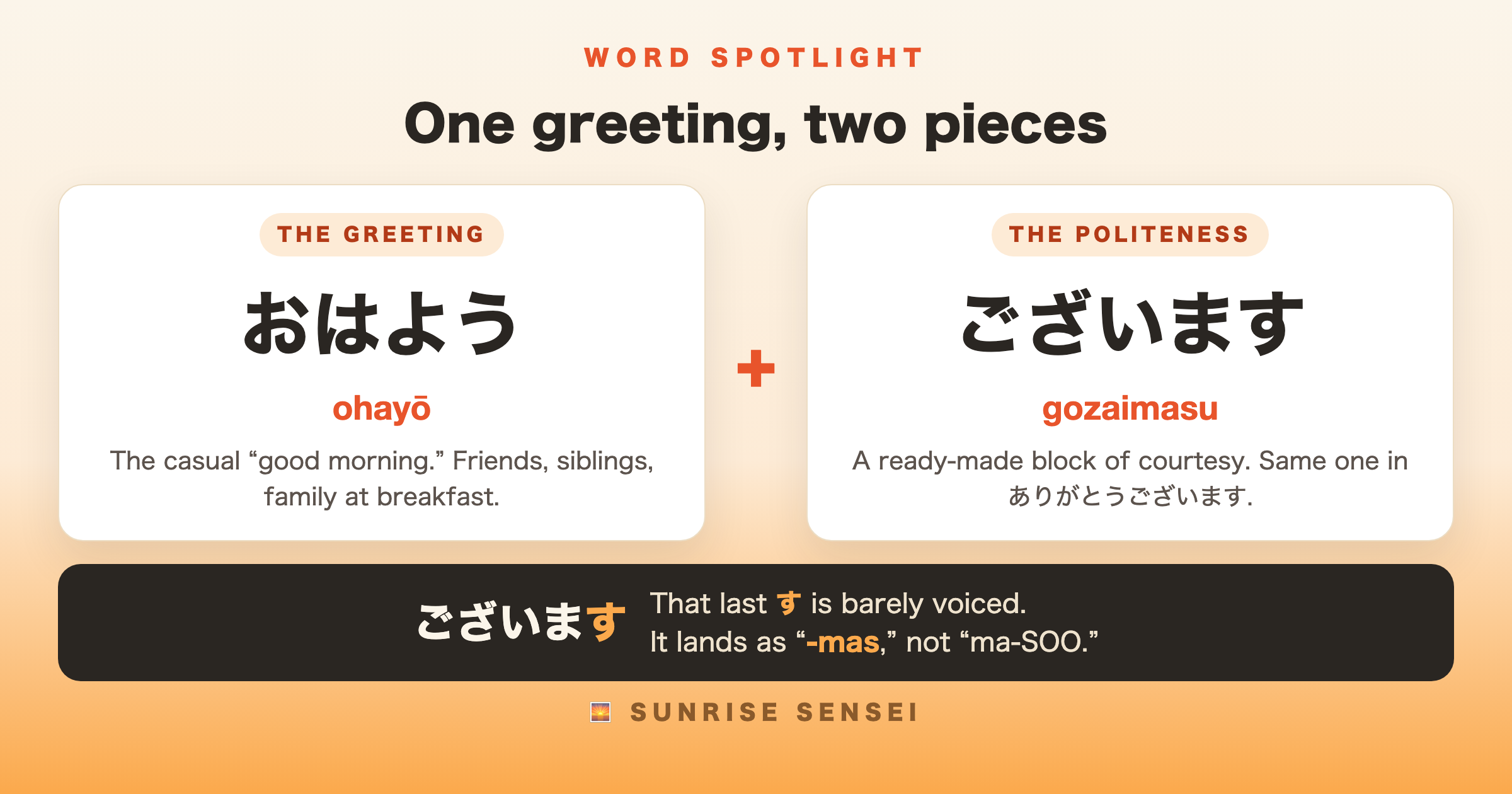
おはよう (ohayō) is the heart of the phrase - the part that actually means "good morning." It's most often said to come from お早い / お早く (o-hayai / o-hayaku), a polite way of saying "early." Picture greeting someone who's already up and moving early in the day - a warm little "you're up bright and early." That's the feeling the word grew out of. The お at the front is a soft, polite prefix that Japanese attaches to many everyday words to make them gentler, and over time お早く rounded off into the おはよう we say today. (That's the standard, commonly-taught story - a lovely way to remember the word, even though the real history is centuries deep.)
ございます (gozaimasu) is the politeness. On its own it's a very polite verb meaning, roughly, "it is" or "there is," descended from an older word, ござる (gozaru). Japanese builds respect right into its verbs, and ございます is one of the most useful polite endings you'll ever meet. You may already know it from another phrase nearly every beginner learns early: ありがとうございます (arigatō gozaimasu) - "thank you very much." Same ございます, same job: it takes a casual word and dresses it up for anyone.
Put them together and おはようございます is, very literally, something close to "it is early" - said with warmth and respect. Which is exactly how a good "good morning" is supposed to feel.
COMMON MISTAKE ⚠️
Using ございます as a greeting by itself.
Because ございます is the part that "makes it polite," beginners sometimes treat it like a standalone courtesy word - a Japanese "sir" they can tack on or use alone. It doesn't work that way. ございます is a polite verb ending; it needs the phrase in front of it. On its own it isn't a greeting at all, and it will simply confuse the person you say it to.
Learn the whole block as one unit - おはようございます - and say it as one smooth breath. That's how native speakers store it too.
USE IT TODAY ✅
Three small reps. Two minutes, total.
-
Say it nine times, one beat per mora. Out loud, slowly, tapping the table: o-ha-yo-u-go-za-i-ma-su. Then say it at normal speed and let the final す fade to "mas."
-
Attach it to a real trigger. Pick one thing you do every morning - the kettle, the first stair, opening the blinds - and say おはようございます out loud when you do it. Tomorrow's email works far better if the phrase already has a home in your day.
-
Add the nod. Say it once more with a small dip of the head. Feel how the gesture and the words want to happen together. That's the whole ritual in one second.
🌅 You're getting real value here. Imagine practicing every phrase out loud with Yuki, your Sunrise Sensei companion.
HEAR THE JAPANESE AUDIO 🌅
Pro tip: Listen three times.
Once for general meaning.
Once following along with the text.
Once with your eyes closed, focusing purely on pronunciation and rhythm.
ANSWER KEY ✅
おはようございます (ohayō gozaimasu). "Good morning" - the polite, everyone-safe version.
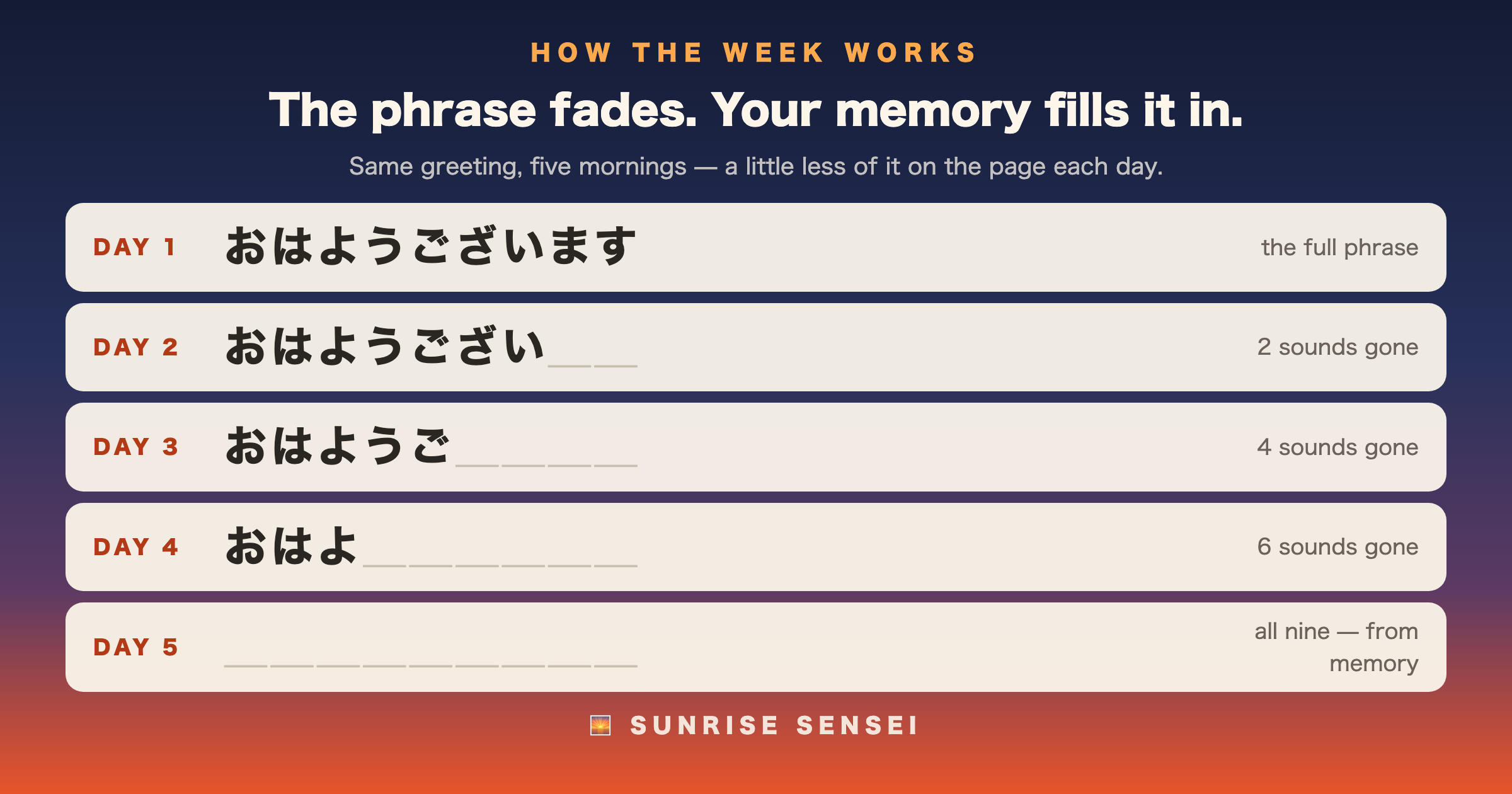
Today's disappeared words: None - Day 1 is always the full phrase. Lock it in.
Here's where the week is going - a little less of the phrase on the page each morning, until you're carrying all nine sounds yourself:
🌅 You nailed it. Ready to go full Japanese?
Billed today · cancel anytime →
How was today's newsletter? Your feedback helps us create better Japanese content for you! (I read every single one!)
🎯 バッチリ! (Batchiri! - Nailed it) My Japanese is growing →
📚 まあまあ (Māmā - so-so). Here's what would help →
See you tomorrow! - 🌅 The Sunrise Sensei Team
Looking for resources?
Get the audio by subscribing below 👇
There's a better way to learn.
Sunrise Sensei delivers one memorable disappearing Japanese phrase to your inbox daily. It’s a simple, effective way to build fluency without the frustration.