Morning! 🌅 ☕️
Yesterday you met the phrase.
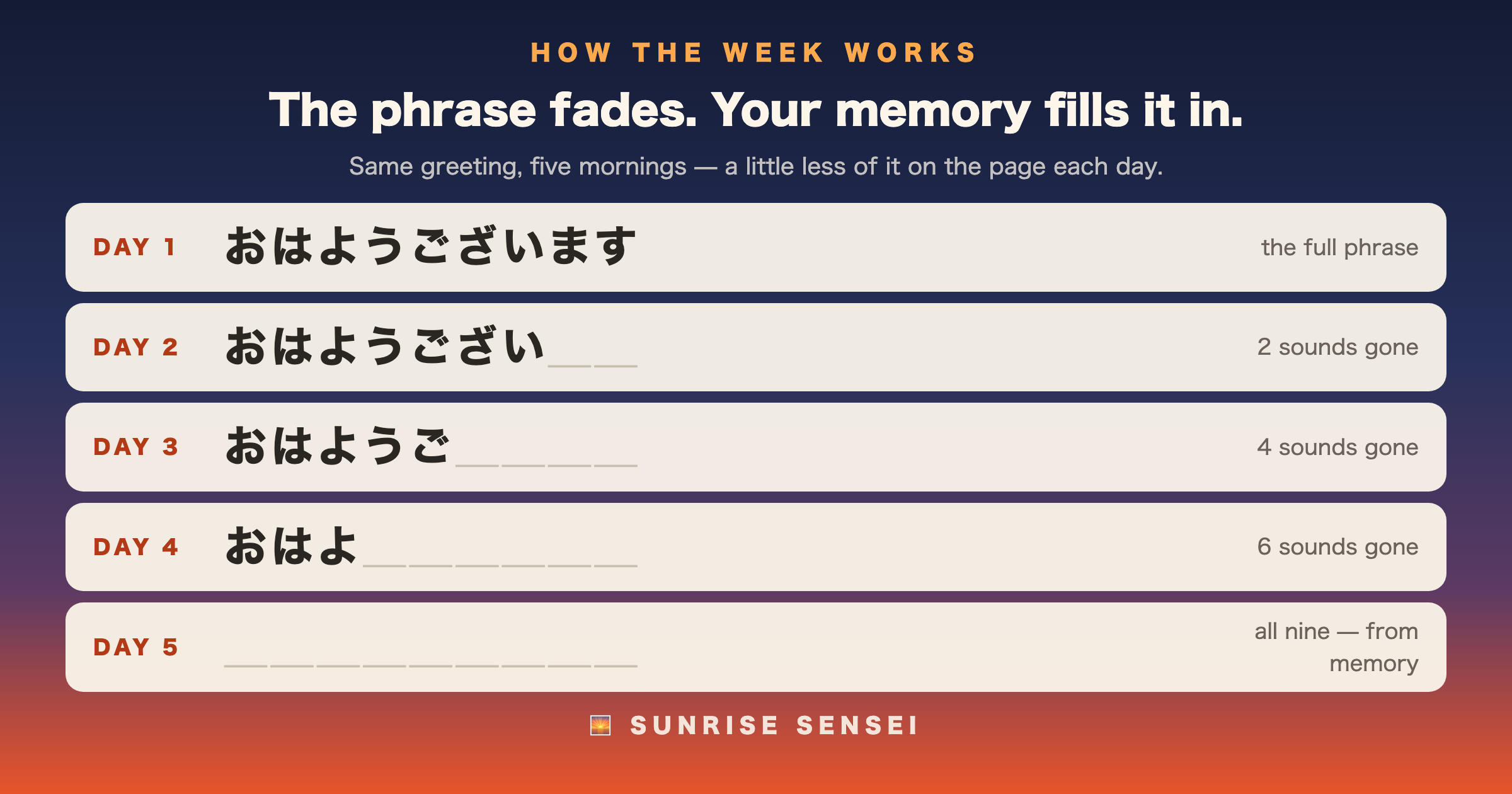
Today, two sounds are gone.
Small ones. The very end. But now your brain has to find them.
That's the whole game - and it works.
In today's email...
-
📱 Day 2: First blanks appear - fill in the ending before you scroll
-
🌟 Where you'll actually hear おはようございます - and the little bow that comes with it
-
🏃 The polite ございます ending, and where else you already know it
📧 subscribe here | ⭐ manage subscription | 📩 keep going after day 30 | 📆 yesterday’s newsletter
MEMORIZE 🧠
おはようござい _ _
o - ha - yo - u - go - za - i - _ - _
(fill in the last two sounds before you scroll)
As always, the answer key and audio are at the bottom of this email.
SAY IT LIKE A LOCAL 🗣️
The two sounds hiding behind today's blanks are also the two most commonly mangled by English speakers. Worth two minutes.
ま (ma) is easy. It's a clean, open "ma," like the start of "mother" - never the flat "muh" that English reduces unstressed syllables to. Give it a full beat.
す (su) is the tricky one. Written, it's "su." Spoken at the end of a phrase, that "u" almost completely disappears - Japanese routinely devoices the u sound when it sits between or after voiceless consonants, and phrase-final す is the classic case. So:
written    ご ざ い ま す      gozaimasu
spoken     go-zai-mas          (the u is breath, not sound)
Say both out loud, back to back: "go-zai-ma-SOO" (the beginner version), then "gozaimas" (the natural one). You'll hear the difference instantly.
One caution the other way: don't chop the す off entirely. It isn't silent - it's a soft, whispered release of air at the end. Think of it as the phrase exhaling.
CULTURAL MOMENT 🌅
Here's something most Japanese learners never think about: a greeting isn't only words. In Japan, おはようございます almost always arrives with a small bow - a gentle dip of the head, not a deep formal one. The words and the bow are one gesture. Beginners tend to focus so hard on saying the phrase correctly that they forget to move; add even a slight nod and the whole thing suddenly reads as natural and warm.
There's even a name for the polished version of this, taught in Japanese business-manner training: 語先後礼 (gosen-gorei) - "words first, bow after." In formal settings you say the greeting while looking at the person, and then bow, rather than mumbling into your own chest mid-bow. In everyday life nobody's grading you and the two blur together, but knowing the principle explains why a Japanese colleague's greeting looks so composed.
Where will you hear it? Everywhere, in the morning. Neighbors greet each other over the fence. Coworkers say it as they walk into the office. A shopkeeper offers it as they open up. In many homes, family members say a softer おはよう to each other at breakfast. It's the sound of a day beginning, repeated millions of times across the country every single morning.
There's one lovely quirk worth knowing. In some workplaces - think theaters, TV studios, kitchens, and part-time jobs - おはようございます is used as the very first greeting of a shift, even if that shift starts in the afternoon or at night. The idea is that it marks the start of our time working together today, not the literal hour on the clock. You don't need to use it that way yourself, but if you ever hear "good morning" at 8 p.m., now you'll know it isn't a mistake.
The point isn't to memorize every setting. The point is to feel how ordinary and how constant this phrase is. When you say おはようございます, you're stepping into a small daily ritual that nearly everyone in Japan shares - a soft, reliable way of saying I see you, and today is beginning.
WORD SPOTLIGHT 🔍️
Today's disappeared sounds: ま (ma) and す (su)
These two little sounds are the tail end of ございます - and that tail shows up all over polite Japanese.
ます (masu) is one of the first patterns you'll meet as a learner. It's the polite ending that gets attached to verbs: tabemasu (I eat), ikimasu (I go), shimasu (I do). Whenever a Japanese sentence wants to sound courteous, it tends to end in ます. So the ま and す you're filling in today aren't random - they're the exact sounds that signal "I'm being polite" in countless everyday phrases.
Here's the same tail doing the same job in phrases you'll meet constantly:
おはようございます   ohayō gozaimasu    good morning (polite)
ありがとうございます  arigatō gozaimasu  thank you very much
わかりました         wakarimashita      I understand / got it
いらっしゃいませ      irasshaimase       welcome in (shop staff)
Notice how gently that ending lands in every one of them: in real speech the final す is almost whispered, closer to "mas" than "ma-su."
The more you watch ます and ございます disappear and come back like this, the faster your ear starts treating them as the natural, polite way to finish a phrase - exactly the way native speakers do without thinking.
COMMON MISTAKE ⚠️
Over-pronouncing the final u - "go-zai-ma-SOO."
This is the single most recognizable beginner tell in the entire phrase, and it comes straight from reading romaji as if it were English. The spelling says su, so learners land hard on a full "soo" sound - and it instantly marks the speaker as reading rather than speaking.
The fix is one small thing: let the last beat be air. Shape your mouth for "su," but don't voice the vowel. "Gozaimas." Do that and everything before it sounds better too, because your rhythm stops fighting the language.
IN THE WILD 👂
Listen for this greeting arriving in pairs. In Japan a greeting given is a greeting returned - someone says おはようございます, and you'll almost always hear it echoed straight back, often with the same small nod. Two people, four seconds, and the day is open. That reciprocal beat is a big part of what makes aisatsu feel like glue rather than filler.
USE IT TODAY ✅
Today's reps target the ending you just filled in.
-
Whisper drill. Say ございます ten times, making the final す quieter each round until it's pure breath. Then say the whole phrase once at normal volume - the ending will have fixed itself.
-
Cover and recall. Look away from this email and say the full phrase out loud from memory. Then check. Getting it slightly wrong and correcting is worth more than reading it correctly ten times.
-
Greet and nod. Say おはようございます once to a mirror, or to a real person, with a small dip of the head - words first, then the nod. Feel how much more finished it is than the words alone.
🌅 You're getting real value here. Imagine practicing every phrase out loud with Yuki, your Sunrise Sensei companion.
HEAR THE JAPANESE AUDIO 🌅
Pro tip: Listen three times.
Once for general meaning.
Once following along with the text.
Once with your eyes closed, focusing purely on pronunciation and rhythm.
ANSWER KEY ✅
おはようござい ま す (ohayō gozaimasu).
"Good morning" - the polite, everyone-safe version.
Today's disappeared sounds: ま (ma), す (su)
🌅 You nailed it. Ready to go full Japanese?
Billed today · cancel anytime →
How was today's newsletter? Your feedback helps us create better Japanese content for you! (I read every single one!)
🎯 バッチリ! (Batchiri! - Nailed it) My Japanese is growing →
📚 まあまあ (Māmā - so-so). Here's what would help →
See you tomorrow! - 🌅 The Sunrise Sensei Team
Looking for resources?
Get the audio by subscribing below 👇
There's a better way to learn.
Sunrise Sensei delivers one memorable disappearing Japanese phrase to your inbox daily. It’s a simple, effective way to build fluency without the frustration.