Morning! 🌅 ☕️
Four sounds gone today.
The whole polite ending is starting to disappear.
Can you still hear it in your head?
Close your eyes for three seconds before you scroll to the phrase. Try to say it out loud first.
That's where fluency lives.
In today's email...
-
📱 Day 3: Four blanks - the polite ending is fading out
-
🌟 The mistake beginners make when they pick the wrong level of politeness
-
🏃 How to read the moment and choose おはよう or おはようございます
📧 subscribe here | ⭐ manage subscription | 📩 keep going after day 30 | 📆 yesterday’s newsletter
MEMORIZE 🧠
おはようご _ _ _ _
o - ha - yo - u - go - _ - _ - _ - _
(the whole polite tail is up to you now)
As always, the answer key and audio are at the bottom of this email.
CULTURAL MOMENT 🌅
Most beginners learn one version of "good morning" and use it for everyone. That's where the small stumbles happen - not because they said the wrong words, but because they picked the wrong level.
Remember the two versions. Casual おはよう (ohayō) is for people you're close to and comfortable with: a good friend, a sibling, family at the breakfast table. Polite おはようございます (ohayō gozaimasu) is for everyone else: a teacher, a boss, a coworker you don't know well, a neighbor, a shopkeeper, anyone older, anyone you're meeting for the first time.
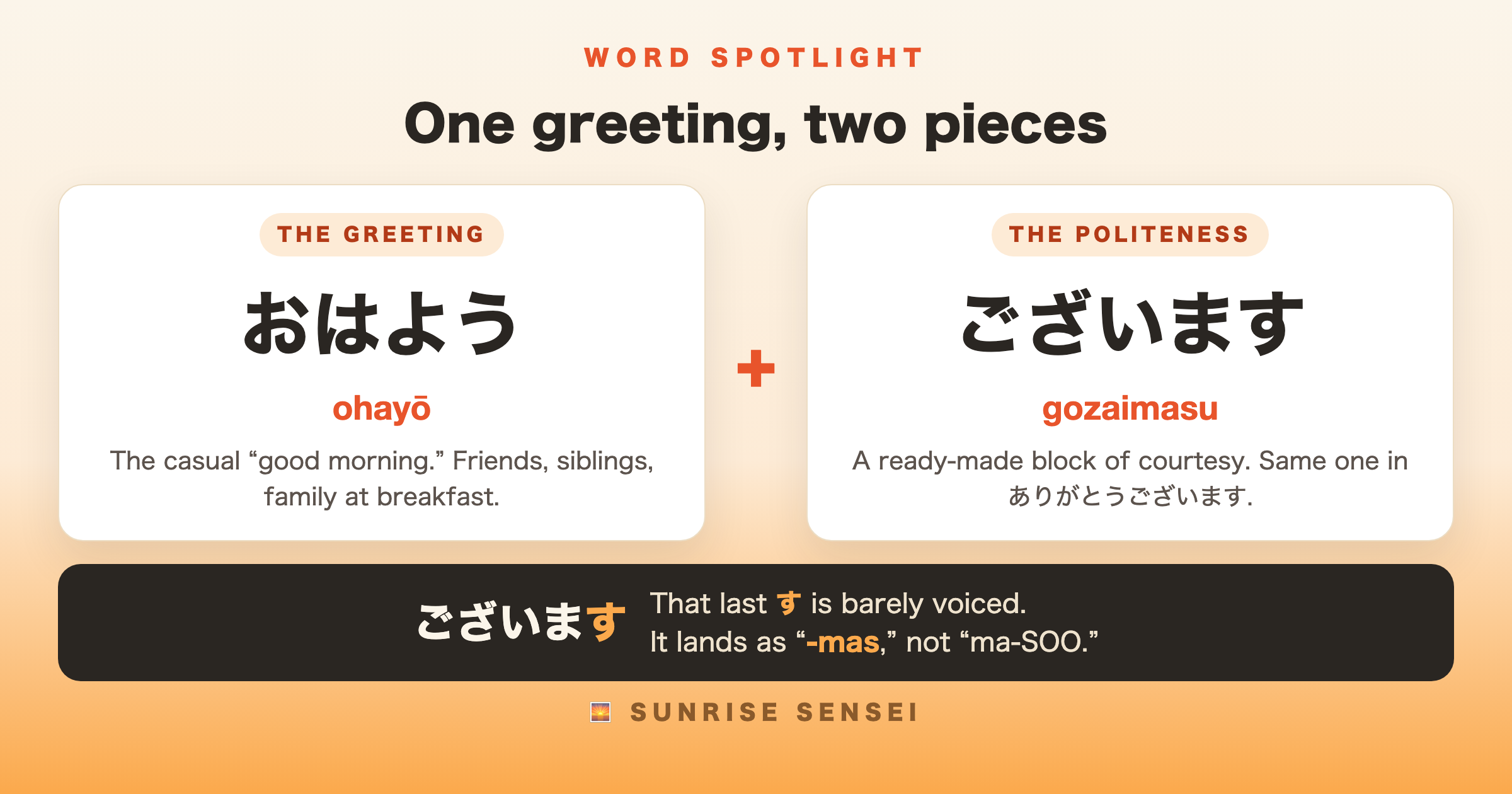
Here's the mistake, and it goes both ways. Using casual おはよう with someone who expects politeness - your manager, a stranger - can come across as a little too familiar, a little careless. And using the full おはようございます with a close friend can feel oddly stiff, like you're keeping them at arm's length. Neither is a disaster. Japanese people are warm and forgiving with learners. But matching the level to the relationship is exactly the kind of small thing that makes you sound like you get it.
The good news for you as a beginner: when in doubt, go polite. おはようございます is never rude and never wrong. Nobody has ever been offended by too much courtesy in the morning. As you spend more time around people, you'll start to feel who you can relax into casual おはよう with - and that shift, from polite to casual, is itself a quiet sign that a relationship has grown closer.
The real cultural intelligence here isn't just knowing the words. It's reading the moment - who's in front of you, how well you know them - and letting your greeting match. Get that right, and you're already speaking Japanese the way it's actually lived, not just the way it's printed in a textbook.
PICK YOUR LEVEL 🎚️
A quick reference you can actually use. When you're unsure, read down the right-hand column - it's never wrong.
Who's in front of you            Say this
─────────────────────────────    ─────────────────────
Close friend, sibling            おはよう      (ohayō)
Family at breakfast              おはよう      (ohayō)
Classmate you know well          おはよう      (ohayō)

Boss, teacher, senior            おはようございます
Coworker you don't know well     おはようございます
Neighbor, shopkeeper             おはようございます
Anyone older than you            おはようございます
Someone you just met             おはようございます
Not sure?                        おはようございます
Notice how much longer the polite column is. That's not an accident - it reflects real life. In a typical Japanese day, most morning greetings are the polite version.
COMMON MISTAKE ⚠️
Using casual おはよう with a boss, a stranger, or a shop's staff.
This is the mistake of Day 3, and it's an easy one to make: おはよう is shorter, it's what you hear in casual anime and drama dialogue, and it feels friendly. But friendliness and politeness aren't the same axis in Japanese. Dropping ございます with someone senior to you doesn't read as warm - it reads as presumptuous, like you've decided the two of you are closer than you are.
There's an important asymmetry here too: a manager may well say casual おはよう down to their team, while the team says おはようございます up. Hearing the short version aimed at you is not an invitation to fire it back.
The fix is the easiest rule in this whole week: when in doubt, add ございます. Four extra syllables, zero risk.
WORD SPOTLIGHT 🔍️
Today's disappeared sounds: ざ (za) and い (i) - which, with yesterday's ま and す, means all of ざいます (zaimasu) is now blank.
What's vanishing today is the middle of ございます, the polite verb that carries the courtesy in this phrase. Look at what's left on the page: おはようご. You're holding onto the casual おはよう plus a single ご, and rebuilding the polite ending entirely from memory.
That polite ending is worth knowing as a set piece. ございます (gozaimasu) isn't something you conjugate or take apart in daily life - Japanese speakers use it as one ready-made block of politeness. You attach it to soften and elevate a phrase, and it always lands the same courteous way. Learn it once as a whole, and it unlocks several phrases at the same time.
One sound to be careful with today: ざ (za) is a true voiced "z" - buzz it, like the z in "zebra." Beginners often soften it toward an "s" or a "j," and ございます quietly turns into something else. Put your fingers on your throat and feel the buzz.
You've already seen this block do its job elsewhere: おはようございます (good morning), ありがとうございます (thank you very much). Same block, different front half. That's a big part of why this greeting is such a smart first phrase - the ございます you're recalling today is a piece you'll reuse for months. The more you rebuild it from memory now, the more automatic it becomes everywhere else.
IN THE WILD 👂
Listen for the level-switch happening in real time. A Japanese employee greets a client with a crisp, full おはようございます and a small bow - then turns to the colleague they've sat beside for six years and lets it collapse into a warm, mumbled おはよ〜. Same person, same thirty seconds, two different relationships. Once you can hear that switch, you're hearing Japanese the way it's actually spoken.
USE IT TODAY ✅
-
Say the polite tail from memory, five times. Just ございます, no front half. It should start to feel like one word, not five sounds - because that's how it's stored in a native speaker's head.
-
Run the level drill. Picture three specific people from your real life: your closest friend, someone you work with but barely know, and a stranger at a shop. Say the correct greeting out loud for each. (Answers: casual, polite, polite.)
-
Rebuild the whole phrase before you scroll. Look away and say all nine sounds. Only then check the answer key. The reach is the exercise.
🌅 You're getting real value here. Imagine practicing every phrase out loud with Yuki, your Sunrise Sensei companion.
HEAR THE JAPANESE AUDIO 🌅
Pro tip: Listen three times.
Once for general meaning.
Once following along with the text.
Once with your eyes closed, focusing purely on pronunciation and rhythm.
ANSWER KEY ✅
おはようご ざ い ま す (ohayō gozaimasu).
"Good morning" - the polite, everyone-safe version.
Today's disappeared sounds: ざ (za), い (i), ま (ma), す (su)
🌅 You nailed it. Ready to go full Japanese?
Billed today · cancel anytime →
How was today's newsletter? Your feedback helps us create better Japanese content for you! (I read every single one!)
🎯 バッチリ! (Batchiri! - Nailed it) My Japanese is growing →
📚 まあまあ (Māmā - so-so). Here's what would help →
See you tomorrow! - 🌅 The Sunrise Sensei Team
Looking for resources?
Get the audio by subscribing below 👇
There's a better way to learn.
Sunrise Sensei delivers one memorable disappearing Japanese phrase to your inbox daily. It’s a simple, effective way to build fluency without the frustration.